Cloud kitchen in Thailand: what it is and what it costs
What a cloud kitchen is, how the delivery-only model works in Bangkok, a full monthly cost breakdown in baht, the break-even order count, and when it is the wrong call.
A cloud kitchen is a restaurant with no dining room. It cooks only for delivery and takeaway, and sells through GrabFood, LINE MAN and its own ordering link. It saves on rent, fit-out and front-of-house staff, but every app order loses about 32% of its food value to commission and VAT. In our worked example, a small Bangkok kitchen with ฿63,000 a month in fixed costs needs about 38 orders a day at a ฿180 average just to break even. It works when your dishes travel well, your area has delivery demand, and you price for the commission from day one.

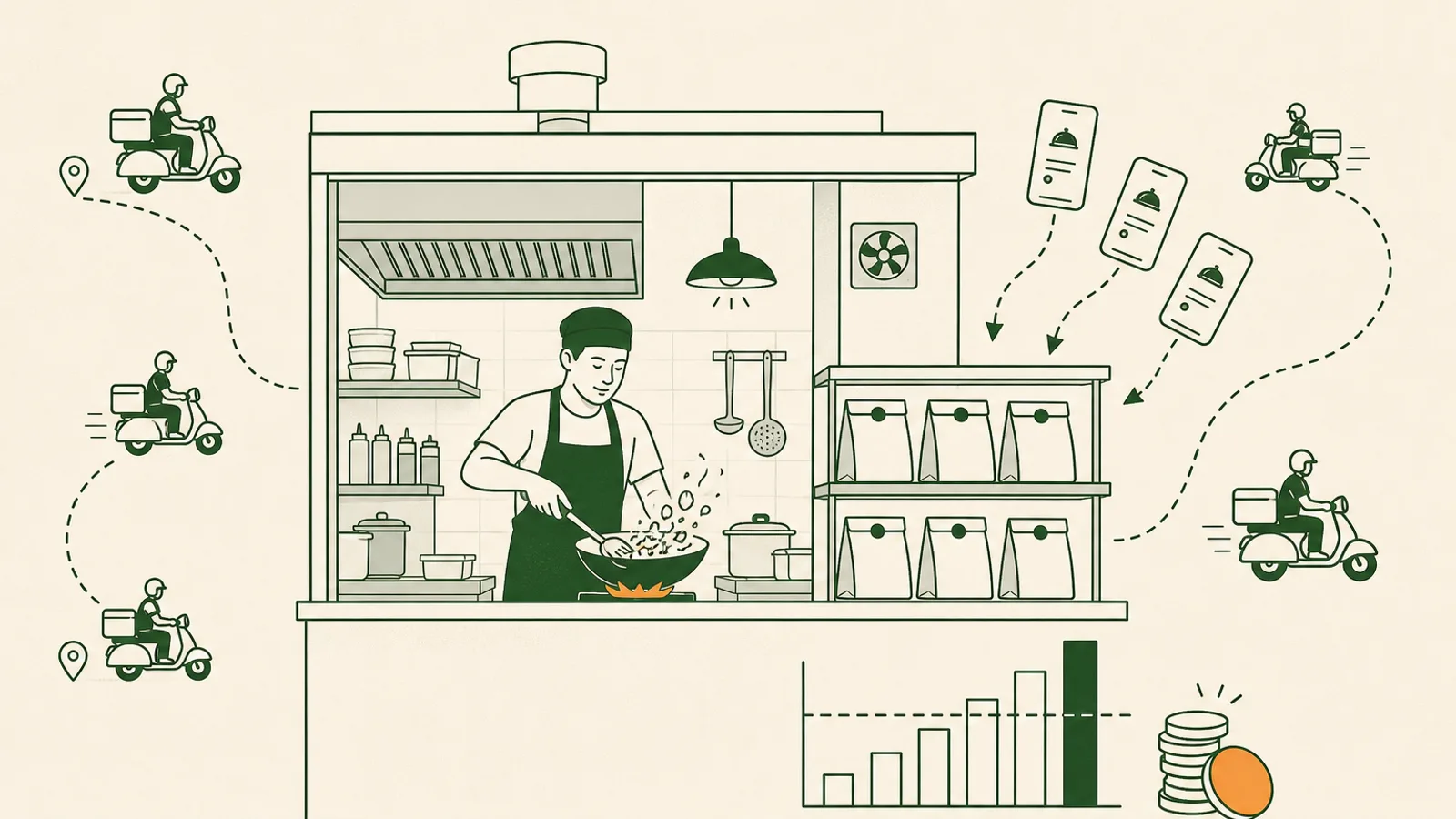
A cloud kitchen is a restaurant without the restaurant part. There are no tables, no waiters and no shopfront on a busy street. There is a kitchen, a pass, a shelf of delivery bags, and a steady stream of riders coming to the door. Customers find you on GrabFood, LINE MAN or your own ordering link, and that is the only way they ever meet your food.
The model became popular in Bangkok during the pandemic, and it has stayed because the logic still holds: if most of your orders arrive by motorbike anyway, why pay prime rent for seats nobody uses? But the savings on the dining room come with a new cost on every order, and the maths is less forgiving than it looks. This guide explains what a cloud kitchen is, the main ways to run one, what it really costs in baht, and how to tell whether it will pay.
What a cloud kitchen is, and what it isn't
You will hear several names for the same idea:
- Cloud kitchen, ghost kitchen, dark kitchen. All three mean a kitchen that cooks only for delivery and takeaway. There is no difference that matters to an operator.
- Virtual brand. A delivery-only menu, with its own name and logo, that runs out of a kitchen that already exists. A Thai restaurant that also sells a fried-chicken brand on Grab from the same kitchen is running a virtual brand.
- Central kitchen. A kitchen that preps food for a chain's own branches. It may also sell delivery, but its main job is supplying the outlets. In Thai, the word for this is often used loosely for cloud kitchens too, which causes some confusion.
What makes a cloud kitchen different is not the cooking. It is where the customer relationship lives. A dine-in restaurant owns the room, the welcome and the bill. A cloud kitchen hands most of that to a delivery app, and pays for it.
Four ways to run a cloud kitchen in Bangkok
Most Thai cloud kitchens fit one of four shapes, and each carries a different level of risk.
- A virtual brand inside your existing restaurant. The cheapest start. You already pay the rent, the gas and the cooks, so a second menu on the apps only needs ingredients, packaging and some photos. The risk is that it slows your main kitchen at peak.
- Your own delivery-only kitchen. A small shophouse or unit in a dense delivery area, fitted out for cooking only. Rent is lower than a street-front restaurant, but you carry the full fixed cost and every baht of revenue arrives through delivery.
- A rented space in a shared kitchen. Some operators rent fitted kitchen units in a building that houses several brands. You save on fit-out and set-up time, and pay for it in rent and contract terms. Read those terms closely before you sign.
- A home kitchen. Many Thai delivery brands start here, cooking a short menu from a home kitchen and selling through the apps. It costs the least, but it limits your volume, and you still need the right paperwork.
For a first brand, the order above is roughly the order of risk. Testing a menu as a virtual brand before you commit to a lease is the cheapest lesson you can buy.
Cloud kitchen cost: one month in baht
Here is a worked example for a small Bangkok cloud kitchen. The figures are illustrative, so swap in your own.
- 60 orders a day, 30 days a month, an average order of ฿180
- Food cost at 33% of the menu price
- Packaging at ฿7 an order
- GP of 30%, with 7% VAT charged on the GP, so 32.1% of the food value
- Rent ฿25,000, two cooks at ฿15,000 each, gas and electricity ฿8,000
- All orders through the delivery apps, and the kitchen is not VAT-registered
| Per month | |
|---|---|
| Food value of orders (1,800 × ฿180) | ฿324,000 |
| GP and VAT on the GP (32.1%) | −฿104,004 |
| Money you receive | ฿219,996 |
| Ingredients (33%) | −฿106,920 |
| Packaging (1,800 × ฿7) | −฿12,600 |
| Rent, staff and utilities | −฿63,000 |
| Left before your own time and tax | ฿37,476 |
Two numbers stand out. First, commission is the biggest single cost after ingredients, larger than rent and staff combined. Second, the margin is thin: ฿37,476 on ฿324,000 of sales is about 12%, and that is before you pay yourself.
Now the break-even. Each order brings in ฿180 less 32.1% commission, which is ฿122.22. Take off ฿59.40 for ingredients and ฿7 for packaging and you keep ฿55.82 an order to cover fixed costs. Divide ฿63,000 by ฿55.82 and you need about 1,129 orders a month, or 38 orders a day, before the kitchen earns anything. The free break-even calculator runs the same sum with your own numbers.
This is why a cloud kitchen is not automatically cheaper than a small dine-in shop. You save the dining room, but you pay roughly a third of every app order to the platform. Our guide to GrabFood and LINE MAN commission breaks that cost down and shows how to price around it.
The levers that move the numbers
Once you see the cost table, the levers are clear.
- Price for delivery on purpose. A dish priced like dine-in will not carry a 32% deduction. Cost each dish on the money you actually receive, using the food cost formula, and set delivery prices from there.
- Keep the menu short. Twelve dishes that share ingredients beat forty that do not. A short menu means less stock, less waste and faster tickets at lunch.
- Raise the average order. Sets, add-ons and drinks lift the ticket without much extra work. Moving the average from ฿180 to ฿200 in our example adds about ฿12,500 a month at the same order count, even with food cost staying at 33%.
- Grow your direct orders. Orders through your own link carry no platform commission. If 20% of the orders in our example came direct, the commission bill would fall by about ฿20,800 a month, less what you pay for payment processing and couriers.
- Cut the dishes that lose money. Some dishes cannot carry the commission at any price customers will pay. Menu engineering shows which ones to drop.
Running several brands from one kitchen
Once one brand works, the natural next step is a second brand from the same kitchen. A rice-bowl kitchen adds a noodle brand. A fried-chicken brand adds a wings-and-beer-snacks brand for the evening. Each brand shows up separately in the app, reaches different searches, and shares the same cooks, fryer and cold store.
Done well, this spreads your fixed costs over more orders. Done badly, it creates three problems at once: one cook watching four tablets, ingredients counted four different ways, and no clear idea which brand is actually earning. Before you add a brand, make sure you can answer two questions for each one: what it costs to make each dish, and what is left per order after commission. If you cannot, the second brand will hide losses rather than add profit.
Also check each platform's rules on how many listings it allows from one address, since policies change.
Licences and platforms before day one
A cloud kitchen is still a food business in Thai law. Under the Public Health Act, a food-selling premises over 200 square metres needs a licence from the local authority, while one of 200 square metres or less needs to notify the authority and receive a notification certificate, as The Standard summarises. Most small cloud kitchens fall into the second group. Apply at your district office or municipality before you start selling.
Getting onto the apps is the easy part. Grab lets you register yourself in the GrabMerchant app, and LINE MAN registration runs through the Wongnai Merchant app. Neither requires a dining room. Expect to provide an ID card, a bank account, your kitchen address and clear photos of your menu and cooking area, and allow a few days for approval.
One kitchen, many tablets: the operational side
The day-to-day problem in most Thai cloud kitchens is not cooking. It is the counter: a Grab tablet, a LINE MAN tablet, a phone for LINE orders and a notebook for the sums, all beeping at once at noon.
This is where a single system helps, and it is worth being exact about what each connection does. In Papaya, Grab orders flow straight into the POS and the kitchen queue through a native two-way integration. Deliverect connects as an aggregator hub for the channels it supports. LINE MAN, foodpanda and ShopeeFood orders are not connected by API today, so staff record and reconcile them on the same screen rather than in a separate notebook. Our guide to multi-channel ordering walks through that setup.
Inside the kitchen, one outlet can carry several menus, each with its own channels and opening hours, which is how a second brand or a late-night menu sits alongside the first. Tickets can be routed to separate printer groups or a kitchen display by station, and marking a dish out of stock stops it being sold. Papaya Stock deducts every sale from the same recipe-level stock, so shared ingredients are counted once and food cost holds up whichever brand or app sold the dish.
For direct orders, Papaya Order gives you a web link with no app to download, PromptPay and cards built in, and delivery dispatch through Lalamove. You can see how this fits a delivery-only operation on our cloud kitchens page.
To be fair about fit: a one-person home kitchen doing fifteen orders a day on one app does not need a full restaurant system yet. The value shows up when you have several channels, several brands or several cooks to coordinate.
When a cloud kitchen is the wrong call
The model is not right for every concept. Think twice if:
- Your food needs the table. Dishes that are best eaten in the first two minutes, or that depend on plating and service, lose a lot in a 25-minute ride.
- Your area is thin on delivery demand. A cheap unit far from dense housing and offices may never reach 38 orders a day.
- Your margin depends on drinks and atmosphere. Bars and many cafés make their money in the room, not in a bag.
- You cannot price for the commission. If your customers will not pay a delivery price that covers GP, the volume will not save you.
In those cases, a strong dine-in shop with delivery as a second channel is often the safer business.
Frequently asked questions
What is a cloud kitchen?
A cloud kitchen is a commercial kitchen that cooks only for delivery and takeaway, with no seating for guests. Customers find it on delivery apps or through its own ordering link. It is also called a ghost kitchen or dark kitchen.
What is the difference between a cloud kitchen and a ghost kitchen?
In practice, none. Both mean a delivery-only kitchen. Some people use "virtual brand" for a delivery-only menu that runs out of an existing restaurant's kitchen, which is one common way to start a cloud kitchen without new rent.
How much does it cost to run a cloud kitchen in Bangkok?
It depends heavily on rent and staffing. In our example, rent, two cooks and utilities come to ฿63,000 a month before food, packaging and commission. At a ฿180 average order and 30% GP, that kitchen breaks even at about 38 orders a day and earns roughly ฿37,000 a month at 60.
Can I sell on GrabFood or LINE MAN without a storefront?
Yes. Both platforms accept delivery-only kitchens. Grab lets you register yourself in the GrabMerchant app, and LINE MAN registration runs through the Wongnai Merchant app. You still need a clear kitchen address and a hygienic cooking space, and the food-business notification or licence from your local authority.
Can one cloud kitchen run several brands?
Yes, and many do. Each brand gets its own name and menu on the apps while sharing the same cooks, equipment and ingredients. The hard part is operations: keeping orders, stock and food cost straight across brands without a separate tablet for each one.
Fewer chairs, same maths
A cloud kitchen removes the dining room, not the restaurant economics. You still live on food cost, labour and rent, and you add a commission line that most dine-in restaurants never see on every order. The kitchens that make it are the ones that do the sums before signing a lease, not after.
So start with the numbers: your fixed costs, your average order, the GP in your contract, and the daily orders you need to cover them. If the break-even count looks reachable for your area, keep the menu tight, price for delivery on purpose, and build the direct orders that carry no commission. If it does not, a virtual brand inside a kitchen you already pay for is the cheaper way to test the idea.
Break-even calculator
Find the covers per day you need to break even.
More on Online & multi-channel ordering
Run dine-in, QR, takeaway and delivery from one menu and one kitchen queue.