EDC machine for restaurants: fees, MDR and how to get one
What an EDC machine is, what MDR really costs a Thai restaurant in baht, bank terminal vs one bundled with your POS, and the six checks to make before you sign.
An EDC machine is the card terminal that reads a guest's card, wallet or QR payment and sends it to a bank for approval. The box is the cheap part: banks rent one for roughly ฿350 to ฿400 a month or bundle it free. The real cost is the MDR, a percentage of every card sale (about 0.55% on Thai debit cards and 1.8% to 2.6% on standard credit cards at one major bank) plus 7% VAT on that fee. Compare the rate first, then check whether the terminal talks to your POS, because re-keying amounts by hand is where the close stops balancing.

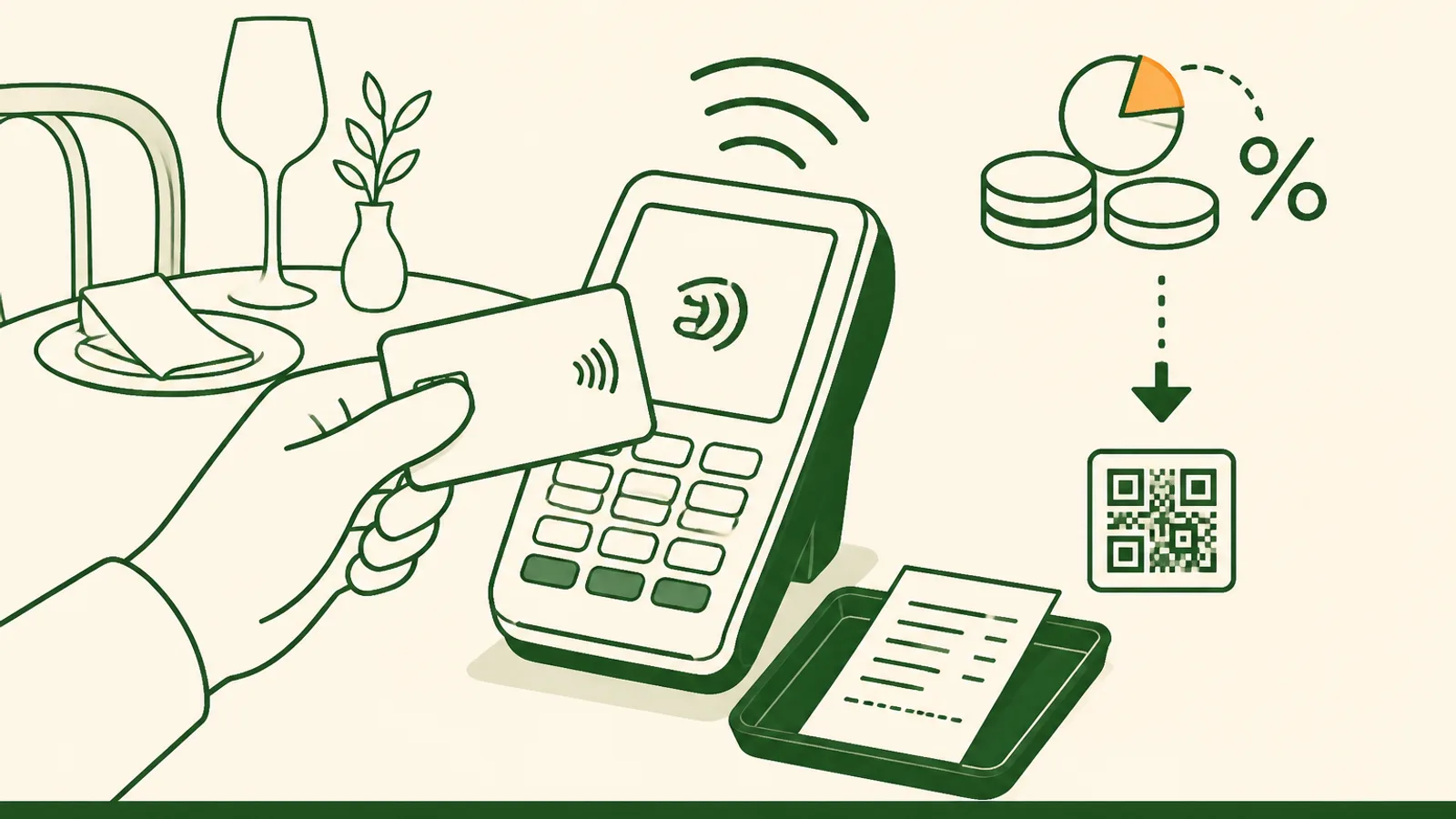
An EDC machine is the card terminal that takes a guest's payment and sends it to the bank. Every Thai restaurant that accepts cards has one, and most owners chose it in about ten minutes, usually whichever their bank or their POS company offered. That is a reasonable way to pick a box. It is a poor way to pick a rate, and the rate is what you pay on every card bill for years.
This guide covers what an EDC terminal actually does, what MDR costs in real baht, a worked example for a mid-sized restaurant, how bank terminals compare with one that comes with your POS, and what to check before you sign. We sell a POS that includes an EDC terminal in Thailand, so we have a stake here. Read the numbers below with that in mind, and check them against any quote you get.
What an EDC machine is and what it does in a restaurant
EDC stands for Electronic Data Capture. The terminal reads a chip card, a contactless tap or a phone wallet, sends the transaction to the acquiring bank, gets an approval or a decline back, and prints or displays a slip. Many current units are Android devices on a mobile data connection, so they walk to the table rather than sitting on a cable at the counter.
The newer terminals also do more than cards. SCB's current Smart EDC, for example, takes debit and credit cards, QR payments and wallets such as Alipay, WeChat Pay and TrueMoney on one device, and KTC's terminal adds QR PromptPay, QR credit and Alipay+. For a restaurant that matters: one device at the table can close almost any bill, which is fewer gadgets on the counter and fewer ways for a tender to go missing.
What the EDC machine does not do on its own is know what the guest ordered. It knows an amount. Whether that amount came from your POS or from a cashier reading it off a screen and typing it in is the difference between a close that balances itself and one that does not. More on that below.
What MDR is, and what it really costs
MDR, the merchant discount rate, is the percentage the acquiring bank keeps from each card sale. It is the main cost of an EDC machine, and it is not one number. It changes by card type, by channel and by your contract.
To make it concrete, here are two banks' published rates at the time of writing:
- SCB lists 0.55% for Thai debit cards, 1.8% to 2.6% for non-Platinum credit cards, 2.5% to 3.3% for QR credit and 1.6% to 1.7% for e-wallets, with a terminal fee of ฿400 a month plus VAT and a ฿3,000 deposit.
- KTC uses 1.5% for a Visa card in its own worked example, and charges ฿350 a month plus VAT for a machine doing under ฿50,000 a month in sales.
Two details catch owners out. First, 7% VAT is charged on the MDR itself, so a 2% rate is really 2.14% of the sale. On a ฿10,000 bill at 2%, the fee is ฿200, VAT on the fee is ฿14, and ฿9,786 reaches your account. Second, premium and foreign cards cost more. A room full of tourists paying on rewards cards pushes your blended rate toward the top of the range, not the bottom.
A worked example: card fees for a ฿600,000-a-month restaurant
Take a 50-seat restaurant in Bangkok doing ฿600,000 a month. Say 30% of that, ฿180,000, comes in on cards, split ฿120,000 credit and ฿60,000 debit. The rest is PromptPay and cash.
Using SCB's published range with a 2.0% credit rate:
- Credit: ฿120,000 × 2.0% = ฿2,400
- Debit: ฿60,000 × 0.55% = ฿330
- VAT on those fees: ฿2,730 × 7% = ฿191
- Terminal rental: ฿400 + VAT = ฿428
That is about ฿3,349 a month, or roughly ฿40,200 a year, to accept cards. Of that, the terminal is ฿5,136 a year. The other ฿35,000 is rate.
Now look at what half a percentage point does. If your credit rate is 2.5% instead of 2.0%, you pay ฿600 more a month in fees, plus ฿42 in VAT, which is about ฿7,700 a year. That is more than a year of terminal rental. This is why "free EDC machine" should never be the headline of a quote. A free box at a worse rate can cost more than a rented box at a better one.
The same maths explains why PromptPay QR spread so fast in Thai restaurants. Every bill a guest pays by bank transfer QR instead of a credit card moves off the most expensive line. Do not assume PromptPay is free for a business, though; merchant QR fees and payout terms vary by provider, so ask for that rate in the same quote as the card rate.
Bank EDC vs a terminal that comes with your POS
There are two common ways to get an EDC terminal in Thailand, and both are legitimate.
Straight from a bank. You apply to KBank, SCB, Krungthai, Bangkok Bank, Krungsri or a card issuer like KTC. The upside is a direct relationship with the acquirer, and for a high-volume business, room to negotiate the rate. The downsides are paperwork, a monthly fee or deposit, and a terminal that usually does not know your POS exists. Your cashier reads the total off one screen and types it into the other.
Bundled with your POS. Many Thai POS companies now include a terminal. FoodStory offers an EDC add-on, and on Papaya's Thai plans the Starter (฿1,490) and Pro (฿2,490) tiers each include one EDC terminal per outlet. The upside is one supplier, no capital outlay and, depending on the setup, the amount sent from the POS rather than keyed by hand. The thing to check is the rate, exactly as you would with a bank. "Included" means the box is free, not the transactions.
Neither route is automatically cheaper. A busy restaurant with a strong banking relationship may get a better card rate direct. A new opening that wants one bill and no deposit will usually prefer the bundle. Ask both for the rate by card type and do the maths above with your own mix. If you are pricing the whole counter rather than only the terminal, our restaurant POS hardware guide lists every piece in baht.
Standalone vs integrated: why the close stops balancing
This is the part most owners discover after they sign.
A standalone EDC machine is a separate island. The POS says the table owes ฿2,340. A server walks the terminal over, types 2,340, the guest taps, and the server goes back to the POS and marks the bill paid by card. Three places for a mistake: a mistyped amount (฿2,430), a bill marked "card" that was actually paid by QR, or a payment taken on the terminal and never closed in the POS. On a slow Tuesday you catch these. On a Saturday with 90 covers, they show up at midnight as a card total that does not match the bank slip.
An integrated terminal removes the typing. The POS sends the amount to the terminal, the guest pays, and the approval comes back and closes the bill against the right order and the right tender. The card payments recorded in your POS are the same transactions the bank will settle, because there was only ever one of each.
The EDC terminals that come with Papaya Pay work the integrated way. When a server takes payment in Papaya POS, the bill amount is sent to the terminal, and the approved or declined result comes back and records the payment against that order, so nobody types the total twice. Depending on the terminal model, the same device takes card, PromptPay QR and wallets such as TrueMoney, LINE Pay, WeChat Pay and Alipay. If a terminal drops its connection halfway through a payment, a manager can still settle the bill by hand, so an outage does not leave a guest standing at the table. Split bills and mixed tenders on one table are a separate problem, covered in our restaurant billing guide. Whichever system you choose, ask to see this flow on a real terminal before you sign. It is the single feature that most changes how your close feels at midnight.
How to get an EDC machine in Thailand
If you go to a bank directly, the requirements are broadly similar across the major acquirers. Expect to need:
- A physical shop in Thailand selling legal goods or services. Online-only businesses go through a payment gateway instead.
- ID and business registration. Personal ID for a sole proprietor; company certificate and director ID for a company. SCB asks that registration documents be no older than six months.
- A bank account, usually with the same bank, since that is where settlements land.
- Shop photos showing the storefront and the counter.
- For some banks, recent statements and a lease. KTC asks for four months of bank statements and a lease or company certificate.
Approval is not instant and banks ask follow-up questions, so start before opening week, not during it. If your POS includes a terminal, the onboarding runs through them instead, but you will still need the same business documents for the underlying merchant account.
Six things to check before you sign
- The rate by card type. Debit, standard credit, premium credit, foreign cards, QR credit and wallets. A single headline rate hides the expensive lines.
- VAT on the fee. Confirm whether the quoted rate is before or after the 7%. It is almost always before.
- Settlement timing. KTC settles card and PromptPay the same day and Alipay+ the next day; SCB pays the next business day. For a restaurant paying suppliers weekly, a day matters.
- The monthly fee and any minimums. Some fees are waived above a sales threshold. Check what happens in a slow month.
- Which methods one terminal takes. If the same device handles card, PromptPay and the wallets your guests use, you carry one gadget per server, not three.
- Whether it talks to your POS. Ask the plain question: "Does the bill amount appear on the terminal by itself, and does the payment close the bill by itself?" If either answer is no, you are signing up for manual reconciliation.
Frequently asked questions
What is an EDC machine?
EDC stands for Electronic Data Capture. It is the card terminal at the counter or the table that reads a chip, a contactless tap, a wallet or a QR payment, sends it to the acquiring bank for approval, and prints or shows a slip. In Thailand most are rented from a bank or bundled by a POS company.
What is MDR, and how much is it in Thailand?
MDR (merchant discount rate) is the percentage the acquirer keeps from each card sale. It varies by card type and contract. SCB's published merchant rates, for example, are 0.55% for Thai debit cards, 1.8% to 2.6% for non-Platinum credit cards and 2.5% to 3.3% for QR credit, and 7% VAT is charged on top of the fee itself.
How much does an EDC machine cost to rent?
Bank terminals typically carry a monthly fee in the low hundreds of baht. At the time of writing SCB lists ฿400 a month plus VAT with a ฿3,000 deposit, and KTC lists ฿350 a month plus VAT for a machine doing under ฿50,000 a month in sales. Some POS plans include the terminal at no extra cost, but the per-transaction fee still applies.
What documents do I need to apply for an EDC machine?
Expect to provide ID, business registration, a bank account (usually with the acquiring bank), photos of the shop and, for some banks, recent bank statements and a lease or company certificate. A physical shop in Thailand selling legal goods is a baseline requirement.
Does Papaya include an EDC machine?
Yes. In Thailand the Starter (฿1,490) and Pro (฿2,490) plans include one EDC terminal per outlet, with a 30-day free trial and no setup fee. Processing fees still apply per transaction. See [pricing](/pricing) for the current bundle.
Rent the box, negotiate the rate
An EDC machine is one of the smallest purchases you will make for a restaurant and one of the longest-running costs. The box is a few hundred baht a month or free. The rate is a slice of every card bill you will ever take, and half a percentage point of it is worth more than the terminal itself. So when the quote lands, read it in this order: the rate by card type, the VAT on top, when the money settles, and whether the terminal talks to your POS or makes a cashier type every amount twice. Get those four right and the free box is a genuine bonus rather than the reason you signed.
More on Choosing a POS
Buy the right restaurant POS — the questions, trade-offs and fees that actually matter.