Cafe POS system: what a Thai coffee shop really needs
How to choose a cafe POS system in Thailand: counter speed, cost per cup, QR ordering, loyalty for regulars, and when a free till is still enough.
A cafe POS system is judged on four things: how fast a drink with three modifiers gets rung up, whether it costs milk, syrup and beans per cup, whether regulars get recognised without an app, and whether PromptPay settles into the same report as cards. If you run one counter with a short queue, a free till is still the honest answer. The moment you add table service, a second branch, or milk you cannot account for, a paid cafe point of sale starts paying for itself.

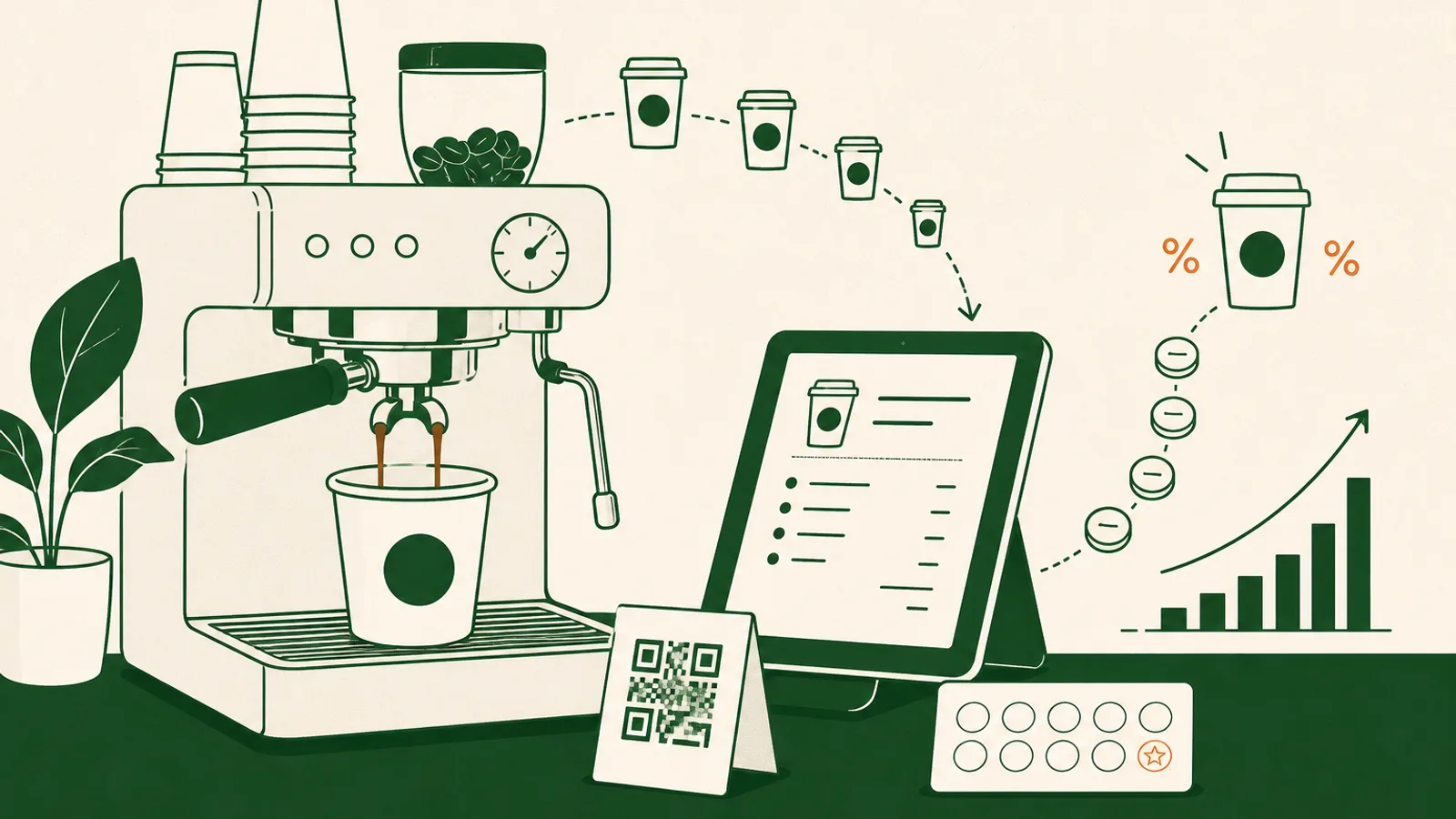
A cafe POS system lives or dies on the 8:15am queue. Not on its feature list, not on its dashboard, on whether a flat white with oat milk and less sugar gets rung up in three taps while six people wait. That is the whole test. This guide covers what a cafe point of sale has to get right in Thailand: counter speed, the cost of milk and beans per cup, QR ordering for the table, loyalty for regulars, PromptPay landing in the same report as cards, and the honest boundary where a free till is still the better buy. Written for owners and managers, so everything below is measured in cups, minutes and baht.
What a cafe POS system has to get right at the counter
A restaurant rings up 60 different dishes across an evening. A cafe rings up the same eight drinks 300 times, each one slightly different. That inverts what matters. Screen layout beats reporting depth, because the difference between three taps and seven taps on a latte is roughly ten seconds, and ten seconds times 300 orders is nearly an hour of counter time a day.
Three things to test in the demo, with your own menu loaded:
- Modifiers on one screen. Size, milk, sweetness and shots should sit on the same panel as the drink, not behind separate menus. If your barista has to back out to change oat milk, the layout will cost you every busy morning.
- Repeat and reorder. A regular who orders the same iced americano daily should be one tap from a saved order, and the second round for a table should copy the first.
- An open tab for anyone who sits down. Cafes with table service need a bill that stays open while a guest adds a second drink and a croissant, without a new receipt each time.
Ask to ring up your five bestsellers yourself during any demo. A vendor tapping through their own demo menu tells you nothing about your Thai iced tea with three sweetness levels.
Cost per cup is where cafe margin actually leaks
Cafe food cost looks safe on paper. Coffee has a famously good margin, so most owners never cost a cup properly. Then milk spoils, syrup gets over-pumped, a new barista pulls 22g shots instead of 18g, and a 22% cost quietly becomes 30% without a single price change.
Do the arithmetic once and you can see it. A latte at ฿120 with 18g of beans at ฿900 a kilo is ฿16 of coffee, 180ml of fresh milk at ฿60 a litre is ฿11, cup and lid ฿4, so about ฿31 a cup, near 26%. Now change one variable. Oat milk at ฿150 a litre takes the same cup to ฿48, which is 40% unless you charge for the swap. Shots at 22g instead of 18g add ฿4 to every drink, which is ฿1,200 a month at 300 cups a week.
None of that shows up in a sales report. It shows up when your POS holds recipes at ingredient level, so every sale depletes beans, milk and syrup, and a weekly count tells you what you should have left versus what you do. That comparison is the number worth managing, and it is what Papaya Stock is built for. Our food-cost guide walks the same loop for a kitchen.
Queue-busting when the line reaches the door
QR ordering gets pitched at restaurants, but a cafe has two moments where it earns money immediately. The first is the second round: a guest already seated scans the code on the table, orders another cup and something sweet, and nobody has to give up their seat or wave anyone down. The second is a morning queue long enough that people at the back leave, which happens more than owners like to admit.
The thing to check is where the QR order lands. It should arrive in the same ticket queue as counter orders, tagged with the table, so your barista works one list instead of watching a second screen. A separate ordering app that needs someone to key its orders into the till is a second job, not a time saver. Papaya Order is web based, so a guest scans and orders without downloading anything, which matters in a cafe full of tourists and one-time visitors.
Regulars are the business, so make recognition automatic
A cafe with 40 regulars who come four times a week has a more reliable revenue line than a restaurant with 400 first-timers. That is why the loyalty question is not decoration for a coffee shop, it is the retention engine. Paper stamp cards work, sort of, but they tell you nothing: no idea who came back, how often, or what they drink.
Sensible rules for a cafe: point the reward at your quiet hours rather than the morning rush you already sell out, keep the reward small and frequent enough to change a habit, and make joining take one tap at payment. If joining needs an app download, most people will not bother while a queue waits behind them. Papaya Loyalty is built around that, and our loyalty playbook has the rules in full.
Payments a Thai cafe actually gets asked for
In Bangkok the counter question is usually PromptPay, not cards. Whatever cafe POS system you choose has to take PromptPay, cards, TrueMoney, LINE Pay and ShopeePay and settle all of it into one end-of-day figure. If your QR payments live in a banking app and your card takings live in a terminal, someone reconciles two numbers by hand every night, and that person is usually you at 11pm.
Two practical points. Ask whether the payment terminal is included or an extra line item, because on Papaya's Thai plans the Starter and Pro tiers include one free EDC terminal and printer. And ask what happens when your internet drops, since a cafe cannot stop taking coffee money for twenty minutes. Ringing up offline and syncing afterwards is a basic requirement, not an advanced feature.
Delivery orders without a second screen
Plenty of Thai cafes now sell more cake and cold brew through delivery than they do at the counter after 2pm. The honest state of play matters here, because integration claims get loose. On Papaya, Grab is a native two way integration, Deliverect fronts multiple aggregators, and Lalamove handles your own delivery dispatch. LINE MAN, foodpanda and ShopeeFood orders are reconciled on the same screen rather than synced through a live two way API today.
That distinction is worth pressing every vendor on. "We integrate with everything" usually means somebody still keys those orders in twice. Ask specifically which aggregators push orders in automatically and which ones you type, then decide whether that matches how your afternoon actually runs.
When a free till is genuinely enough
If you run one counter, no table service, one staff member on shift and no second branch, a free POS app and a card reader is the right answer, and we would rather tell you than sell you. Papaya earns its keep when there is something to manage: table service, QR ordering, ingredient costing, a second printer, a second outlet. Before that, the value case does not land, and our free POS guide is deliberately blunt about where the free option stops being free.
The signals that you have outgrown it are specific and boring. You are keeping a stock spreadsheet next to the till. Two people ring up at once and the app cannot handle both. Your accountant asks for a report the app does not produce. You open a second branch and cannot see both days' numbers in one place. Any two of those together, and the subscription is cheaper than the workaround.
The second branch changes the maths
Cafe groups grow one shop at a time, and the second shop is where a till stops being enough. You need one central menu you can update once, per-outlet pricing when the mall branch pays higher rent, stock held per location, and a roll-up that shows both shops in one view. Papaya's data model is multi-outlet from the ground up, so a second location is a setting rather than a second system.
Before you sign anything, run the payback yourself. Take the monthly plan price, divide by your average check, and you have the extra cups per day it needs to earn. At ฿2,490 a month and a ฿120 average check, that is about seven cups a day. Then ask what a subscription actually removes: an hour of counter time, an evening of reconciliation, the milk variance you cannot currently see. Our break-even calculator does the covers-per-day version of this in a minute, and Papaya's plans start free for 30 days if you would rather test it in your own morning rush than take our word for it.
Frequently asked questions
What does a cafe POS system need that a restaurant POS does not?
Speed on repeat drinks and modifiers. A cafe rings up the same eight items hundreds of times a day, each with sweetness, milk and size options, so a latte with oat milk and less sugar should take three taps, not a trip through five menus. Cafes also lean much harder on loyalty for regulars and on per-cup ingredient costs, where a restaurant leans on table management and coursing.
How much does a cafe POS system cost in Thailand?
Papaya starts at ฿1,490 per outlet per month for POS Starter and ฿2,490 for POS Pro, with the inventory plans at ฿1,490 and ฿3,990. In Thailand the Starter and Pro plans include one free EDC terminal and printer, and there is a free trial before you commit. Free POS apps cost nothing per month, and for a single counter that is often the right call.
Can a cafe POS track the cost of milk and syrup per cup?
Only if it holds recipes at ingredient level. Costing a latte means 18g of beans, 180ml of milk and any syrup pumps coming off stock every time the drink sells. That is what turns a guess about milk usage into a weekly variance number you can act on, and it is what Papaya Stock is built to do.
Do I need a cafe POS if I have one counter and one staff member?
Probably not yet. One register, no table service, no second branch: a free or near-free till plus a card reader is the sensible call, and we would rather say so. The maths changes when you add table service, a second printer, QR ordering, or a second outlet whose numbers you need in one place.
Can customers order coffee by QR while they sit down?
Yes, and in a cafe it mostly helps with the second round. A guest scans the code on the table, orders another flat white and a slice of cake, and the ticket lands in the same queue as counter orders. No app download, so tourists and one-time visitors can use it too.
Buy for the queue you actually have
Most cafe owners overbuy or underbuy for the same reason: they shop on feature lists instead of on their own morning rush. Stand at your counter at 8:15am and count what actually slows you down. If it is the third modifier on a latte, buy speed. If it is milk you cannot account for at month end, buy ingredient-level costing. If it is the queue reaching the door, buy QR ordering. If none of those hurt yet, keep your free till and spend the money on better beans.
When you do move, run the number rather than the pitch. Take the monthly subscription, divide by your average check, and see how many extra cups a day it needs to pay for itself. For most cafes that number is small enough to be uncomfortable, because the honest answer is usually five or six cups, not fifty.
Break-even calculator
Find the covers per day you need to break even.
More on Choosing a POS
Buy the right restaurant POS — the questions, trade-offs and fees that actually matter.