GrabFood commission in Thailand: GP, VAT and pricing
What GrabFood and LINE MAN commission (GP) really costs a Thai restaurant in 2026, worked through in baht, and how to price your delivery menu so every order still earns.
GrabFood and LINE MAN charge restaurants a commission, called GP, on the food value of each order. The standard rate is around 30%, and VAT at 7% is charged on top of the GP, so the real deduction is about 32%. The reduced 9% to 15% GP that came with the government's co-pay scheme ended with the scheme on 30 September 2026. To keep delivery profitable, cost each dish on the money you actually receive, price delivery separately from dine-in, drop dishes that lose money, and grow the direct orders that carry no commission at all.

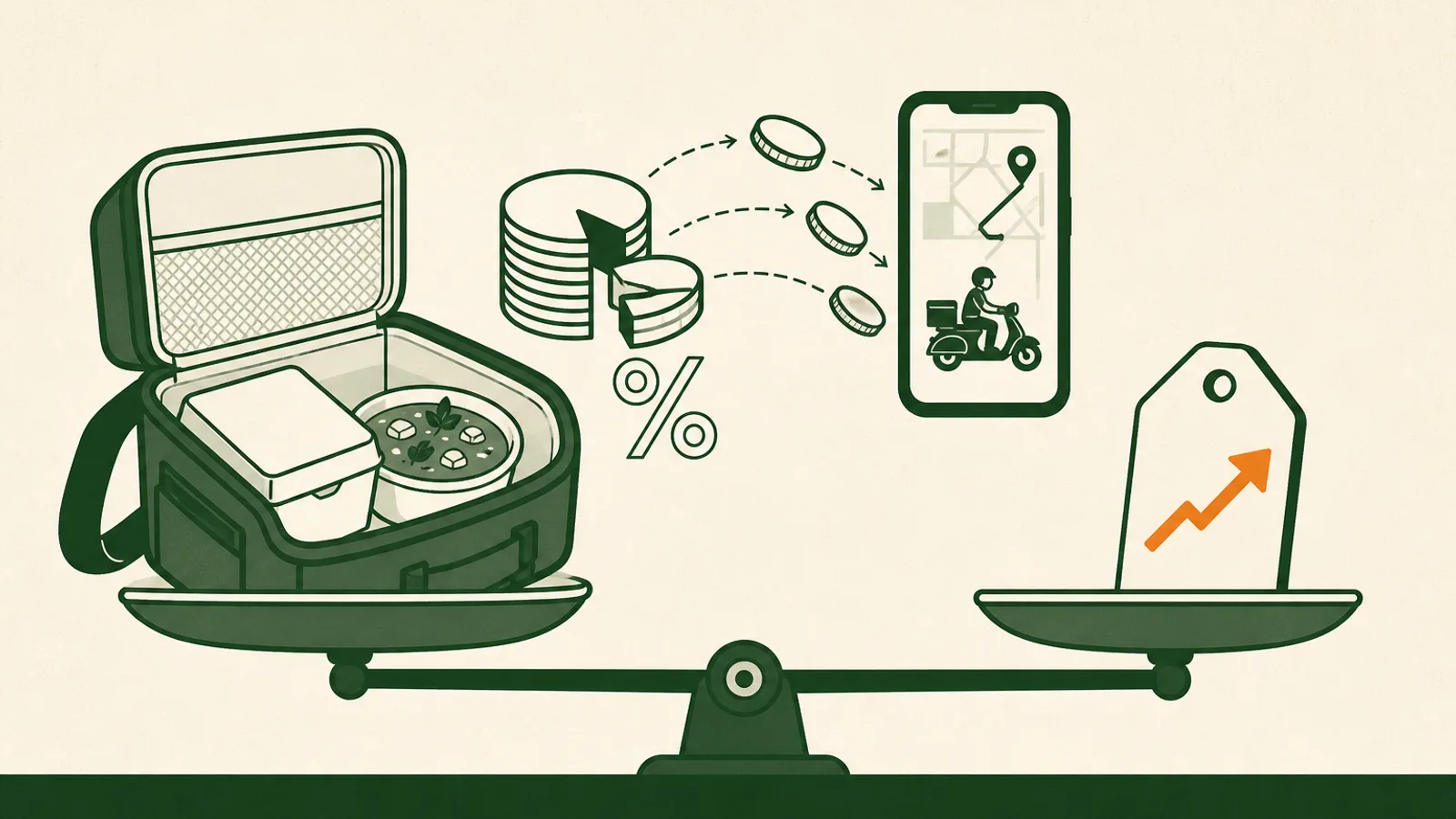
If you sell on GrabFood or LINE MAN, the single biggest cost on every delivery order is not the chicken or the rice. It is the GrabFood commission, the share of each order the platform keeps, which Thai operators call GP. At around 30% plus VAT, it takes roughly a third of the food value before you have paid for a single ingredient.
For four months this year, many restaurants paid far less. During the government's Thai Chuay Thai Plus 60/40 co-pay scheme, Grab and LINE MAN cut GP to between 9% and 15% for participating restaurants. That window closed on 30 September 2026. If you priced your delivery menu while the low rate was running, now is the time to check it again. This guide explains what GP is, what it costs in baht on one real dish, and how to price around it.
What GrabFood commission (GP) actually is
GP stands for gross profit, but on a delivery app it simply means the commission the platform takes from each order. It is a percentage of the food value of the order, the menu prices of what the customer bought. The delivery fee the customer pays the rider is separate and does not reach you.
Two details catch people out:
- VAT is charged on the GP. The platform invoices you for its commission, and that invoice carries 7% VAT. A 30% GP therefore costs you 30% × 1.07, which is 32.1% of the food value.
- Promotions can add to it. If you join a discount campaign that you fund, the discount comes out of your side of the order as well. How the GP is calculated on a discounted order depends on the campaign terms, so read them before you opt in.
What you get for the GP is real: the app, its marketing, payment collection, and above all, customers who would never have found your restaurant on their own. The question is not whether GP is fair. It is whether your prices account for it.
What Grab and LINE MAN charge in 2026
According to Manager Online's August 2026 review of delivery GP in Thailand, the standard rates before VAT are:
- GrabFood: 30%
- LINE MAN: 30%
- ShopeeFood: 30% to 32%
- Robinhood: 28%
During the co-pay scheme, the picture was very different. Grab offered 9% GP to restaurants that registered by 10 June 2026, and 12% for those that joined later. LINE MAN offered 10% to early applicants and 15% after that, according to the Bangkok Post.
Treat these as the market picture, not your number. Individual contracts, categories, exclusivity deals and campaigns all change the rate. Open your GrabMerchant or LINE MAN merchant app, find the commission on a recent statement, and use that.
What GP does to one dish, in baht
Take a green curry with rice. It sells for ฿120 at the table, the ingredients cost ฿40, and a delivery box, lid and bag cost ฿6. To keep the example simple, assume the restaurant is not VAT-registered.
| Dine-in | Delivery at 30% GP | Delivery at 9% GP | |
|---|---|---|---|
| Menu price | ฿120.00 | ฿120.00 | ฿120.00 |
| GP | ฿36.00 | ฿10.80 | |
| VAT on the GP (7%) | ฿2.52 | ฿0.76 | |
| Money you receive | ฿120.00 | ฿81.48 | ฿108.44 |
| Ingredients | ฿40.00 | ฿40.00 | ฿40.00 |
| Packaging | ฿6.00 | ฿6.00 | |
| Left per order | ฿80.00 | ฿35.48 | ฿62.44 |
At the standard rate, the same dish earns ฿35.48 on delivery against ฿80 at the table, less than half. Food cost on the money you actually receive is 49%, not the 33% you see on the menu.
The last column is the scheme rate many restaurants were paying until the end of September. Going from 9% back to 30% takes about ฿27 off every order of this dish. At 50 delivery orders a day, that is roughly ฿40,000 a month.
How to price your delivery menu around GP
There is a simple formula for the delivery price that earns the same baht as dine-in:
Delivery price = (dine-in price + packaging) ÷ (1 − GP × 1.07)
At 30% GP the divisor is 0.679. For the green curry, (฿120 + ฿6) ÷ 0.679 = ฿185.57, so about ฿185. At that price you receive ฿125.62, and after ingredients and packaging you keep ฿79.62, the same as at the table. The free menu-price calculator does the plate-cost side of this for you.
Most restaurants do not go all the way. A ฿65 jump on a ฿120 dish is visible, and customers compare. A common middle path is to recover part of the GP and accept a thinner delivery margin in exchange for the extra orders. At ฿150, the green curry leaves ฿55.85 per order: less than dine-in, but far better than ฿35.48.
A few habits make delivery pricing easier to live with:
- Price per dish, not one flat uplift. A 25% markup across the menu over-charges cheap dishes and under-recovers on expensive ones. Run the formula on your top sellers and decide each one.
- Include the packaging. A ฿6 box is 5% of a ฿120 dish. Cost it like an ingredient, as covered in our guide to the food cost formula.
- Use sets and add-ons. A curry, rice and drink set at a higher ticket carries the GP better than three single items, and add-ons like an extra egg are cheap to make and earn a good margin even after commission.
- Re-check when the rate changes. A price that worked at 12% GP does not work at 30%.
Decide which dishes belong on delivery
Some dishes cannot carry a 32% deduction at any price customers will pay. Expensive proteins with high plate costs, dishes that arrive soggy, and anything that needs plating at the table often lose money or reviews on an app. Removing them from your delivery menu is a pricing decision, not a failure.
Look at each dish on two numbers: food cost on the money you receive, and baht left per order. A dish at 45% food cost on delivery that still leaves ฿70 an order and sells forty a day is worth keeping. A dish that leaves ฿15 and sells three a day is mostly work for the kitchen. Good delivery dishes usually have a low plate cost, travel well for 20 to 30 minutes, and are easy to make in volume at peak.
Check the cost of every promotion before you join
Platforms run frequent campaigns, and joining them can lift your ranking and your volume. Some are funded by the platform, some by you, and some are shared. Before you opt in, work out three numbers for your top dish: the discounted price, the GP and VAT on that order under the campaign terms, and what is left after ingredients and packaging.
If the answer is close to zero, the promotion is buying you visibility, which can still be worth it for a new restaurant or a slow week. Just make it a decision with a budget and an end date rather than a setting you forget about.
Grow the orders that carry no GP
The most reliable way to lower your average commission is not to negotiate a better rate. It is to change the mix, so a larger share of your takeaway and delivery orders come to you directly.
Your regulars already know where you are. Give them a direct way to order: a link on your LINE official account, Instagram and Google Maps listing, and a QR code on every delivery bag. Orders through your own link carry no platform commission. You still pay for card or QR payment processing and the courier, so the saving is not the full 32%, but it is most of it.
With Papaya Order, customers order and pay from a web link with no app to download, PromptPay and cards included, and you can dispatch delivery through Lalamove from the same system. Papaya Loyalty gives regulars a reason to come back to your own channel instead of the app.
Be realistic about it. The apps bring customers who have never heard of you, and that discovery is hard to replace. For most restaurants the goal is a healthy mix: the apps for reach, your own link for repeat customers.
Run every channel from one menu
Delivery margins disappear fastest when every channel is managed separately: one price list on the tablet for Grab, another for LINE MAN, and a dine-in menu that nobody has compared with either. Keeping one master menu with a price per channel makes the decisions above possible.
In Papaya, a dish carries its dine-in price and can carry its own price for each delivery channel, including separate GrabFood and LINE MAN prices. Grab orders flow straight into the POS and the kitchen queue through a native integration. LINE MAN, foodpanda and ShopeeFood orders are not connected by API today, so staff record and reconcile them on the same screen. Every sale, whichever channel it came from, depletes the same recipe stock in Papaya Stock, so your food cost holds up across channels. Our guide to setting up multi-channel ordering walks through the setup step by step.
Frequently asked questions
What is GP on GrabFood?
GP is the commission the platform keeps from each order, a percentage of the food value. It pays for the app, marketing, payment handling and reaching customers who would not have found you otherwise. Rider delivery fees paid by the customer are separate.
How much is the GrabFood commission rate in Thailand?
For most restaurants the standard GP is about 30%, with 7% VAT charged on top of the GP, so roughly 32% of the food value. Rates vary by contract, category and promotion, so the figure in your own GrabMerchant app is the one to use.
Is LINE MAN GP different from Grab?
The standard LINE MAN rate is also around 30% before VAT, according to Manager Online's August 2026 review of the market. Both platforms offered reduced rates to restaurants in the 2026 co-pay scheme. Check your own contract, because individual deals and promotions differ.
How much more should I charge on delivery?
To keep the same baht per dish as dine-in at a 30% GP, divide your dine-in price plus packaging by about 0.68. A ฿120 dish with ฿6 packaging needs about ฿185 to fully break even with dine-in. Many restaurants settle in between and accept a thinner margin for the extra reach.
Can I take delivery orders without paying GP?
Yes, through your own ordering link. Orders from your own website, LINE or a QR code carry no platform commission, though you still pay for payment processing and the courier. The apps bring customers you cannot reach on your own, so most restaurants use both.
Price for the money you keep
GP is not a scam and it is not going away. It is the price of being on the phone of every hungry person within five kilometres, and for many restaurants that reach is worth paying for. What hurts is pricing delivery as if the commission were not there. At 30% plus VAT, a dish that earns ฿80 at the table can earn less than half that on an app.
So run the numbers on your ten biggest delivery sellers, set a delivery price on purpose, cut the dishes that cannot carry the commission, and build up the orders that come to you directly. Do that and delivery becomes a channel you choose, not one that quietly eats your margin.
Menu-price calculator
Price a dish to hit a target food-cost percentage.
More on Online & multi-channel ordering
Run dine-in, QR, takeaway and delivery from one menu and one kitchen queue.