Service charge in Thailand: should your restaurant add 10%?
Service charge in Thailand, explained for restaurant owners: what the rules say, how 10% service charge and VAT add up on a bill, and how to share it fairly with staff.
A service charge in Thailand is an optional fee, almost always 10%, that a restaurant adds to the food and drink subtotal. You may charge it, but only if the rate is shown clearly before guests order, on the menu, at the counter or at the door; if it is not, consumer authorities say the guest does not have to pay it. VAT of 7% then applies on top, because the Revenue Department treats service charge as part of the price of the meal, so ฿1,000 of food becomes ฿1,177. It is the restaurant's revenue first, so if you share it with staff, write the sharing rule down and run it through payroll.

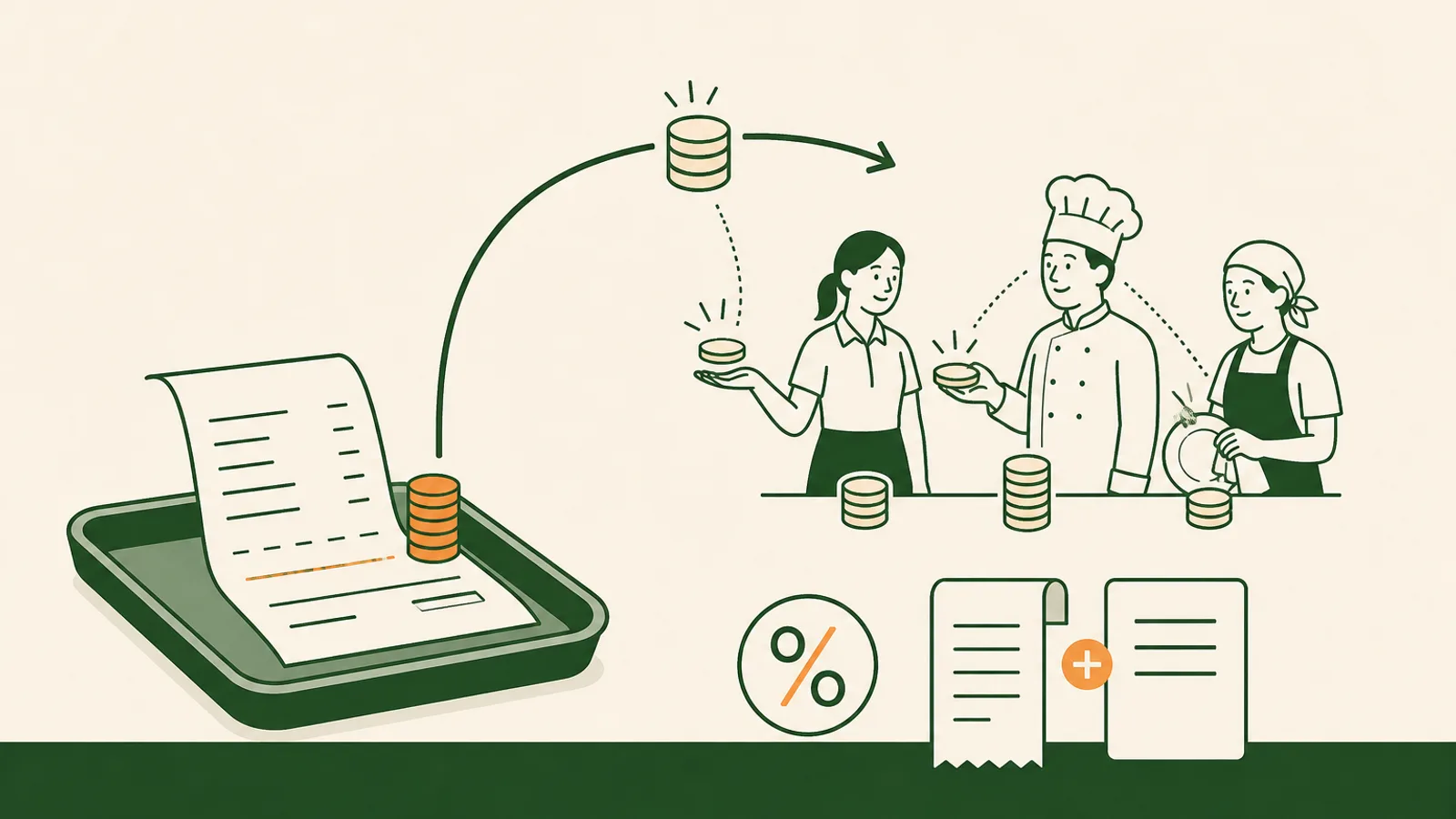
A service charge in Thailand is the 10% you see on a bill below the food, before the VAT. Most diners have met it. Fewer restaurant owners have thought hard about it: whether to add it at all, what the rules actually require, how it interacts with VAT, and what happens to the money once it is collected. This guide works through all four with real numbers in baht, so you can make the decision on purpose instead of copying the restaurant next door.
One note before we start: the tax and labour points below come from published rulings and agency statements, cited as we go. They are a sound starting point, not a substitute for your accountant, who should see your setup before you change it.
What a service charge is, and what it is not
A service charge is a fee the restaurant adds to the bill for table service. In Thailand it is almost always 10% of the food and drink subtotal. It is not a government tax, it is not compulsory, and it is not a tip, even though many guests assume it works like one.
The distinction matters because the three things behave differently:
- VAT (7%) is a tax. You collect it only if you are VAT registered (compulsory once turnover passes ฿1.8 million a year) and you hand it to the Revenue Department.
- Service charge (usually 10%) is your revenue. You choose whether to charge it, and you decide what happens to it afterwards.
- A tip is a voluntary gift from the guest, usually to a specific person or to the team.
Plenty of good restaurants charge no service charge at all and price their menu net. Hotels and upscale dining rooms almost always charge it. Both are legitimate. The trouble starts when a restaurant charges it without being clear about it.
Service charge in Thailand: what the rules say
There is no special "service charge law", but two sets of rules apply.
You must show it before the guest orders. Under Thailand's price display rules, consumer authorities have said a restaurant may collect a service charge only if the rate is displayed clearly in advance, in the menu, at the counter or at the entrance, in readable Thai. Where it is not displayed, the Office of the Consumer Protection Board said guests are not obliged to pay it, and a restaurant that fails to display prices clearly can be fined up to ฿10,000.
10% is the accepted level. The same statements describe 10% as the rate consumers broadly know and accept, and they invite complaints from guests charged more than that. A restaurant that quietly adds 12% is not saving anything; it is starting arguments at the till.
In practice that means one line on every menu page and the QR menu ("prices are subject to 10% service charge and 7% VAT"), a small notice at the counter, and the same wording on the bill. Five minutes of setup removes the most common service charge dispute entirely.
Service charge and VAT: how a 10% service charge adds up
The order of operations is fixed. Service charge goes on the food and drink subtotal first. VAT is then calculated on the subtotal plus the service charge, because the Revenue Department ruled that a food business's service charge is part of the price of the food, and therefore part of the VAT base. The same ruling counts it as the business's taxable income.
On a ฿1,000 table that looks like this:
| Line | Amount |
|---|---|
| Food and drink | ฿1,000 |
| Service charge 10% | ฿100 |
| VAT 7% on ฿1,100 | ฿77 |
| Total | ฿1,177 |
That is what the "++" after a menu price means: the number on the menu, plus service charge, plus VAT, a multiplier of 1.177. A ฿250 dish on a ++ menu costs the guest ฿294.25.
The alternative is net pricing, where the menu price already includes everything. If you want to keep the same money as a ++ menu, the ฿250 dish becomes about ฿294 on a net menu. You collect the same amount; the guest sees a bigger number on the menu and a simpler bill. If you are re-pricing a menu either way, start from your food cost target with the free menu price calculator, then decide how to present it.
Two rules worth getting right in the till, not in a cashier's head:
- No service charge where there is no service. Takeaway, delivery and partner channels where the platform sets the price should not carry it. Neither should a retail jar of chilli paste sold over the counter.
- VAT on the right base. VAT is calculated on food plus service charge, not on food alone. Getting this backwards under-charges VAT on every bill, and the shortfall becomes your cost at filing time.
Should your restaurant charge a service charge at all?
There is no universal answer, but there are clear patterns.
Charging service charge tends to fit full table service with staff taking orders, coursing and clearing; hotel outlets, where guests expect it and the service charge pool is part of how staff are paid; and private dining or large groups.
Net pricing tends to fit counter service and cafés, where guests order and collect themselves; casual neighbourhood restaurants competing on visible price; and restaurants where most guests order by QR and pay at the counter, so there is genuinely less service on the table to charge for.
Then do the maths for your own room. Take a 60-seat Bangkok restaurant with ฿800,000 a month in dine-in food and drink sales. A 10% service charge brings in ฿80,000 a month, close to ฿1 million a year. That money either funds staff pay through the pool, or you raise menu prices around 10% to fund the same wages and skip the line on the bill. Either way the guest pays for service. The choice is about presentation and about how directly your staff feel the link between a full room and their pay.
What does not work is charging it on a counter-service café and then wondering why guests leave reviews about it.
Where the money goes: sharing service charge with staff
Here is the point that surprises people: service charge is the restaurant's revenue first. The Revenue Department taxes it as income and as part of the VAT base. It becomes staff money only because you decide to pay it out.
Most Thai restaurants that charge it share most or all of it with the team, and hotels have long run it as a pool that makes up a real part of staff income. There is no fixed formula, so the two things that matter are fairness and writing it down. A common method is points per role. Using the ฿80,000 example above and a team of 14:
| Role | People | Points each | Payout each |
|---|---|---|---|
| Floor manager | 1 | 3 | ฿9,600 |
| Head chef | 1 | 3 | ฿9,600 |
| Cooks | 3 | 2 | ฿6,400 |
| Cashier | 1 | 2 | ฿6,400 |
| Servers | 6 | 1.5 | ฿4,800 |
| Dishwashers | 2 | 1 | ฿3,200 |
That is 25 points in total, so each point is worth ฿3,200 this month, and the payouts add back to exactly ฿80,000. Pro-rate by days worked so someone who started mid-month gets their share of the days they were there. If you hold anything back, for breakages or for a reserve against a slow month, say so in the written rule rather than deciding afterwards.
On the labour side, Thailand's Supreme Court has held that a hotel's service charge paid out to staff is not "wages" under the Social Security Act (ruling 5734/2561). How your payout is treated for withholding tax and for any guaranteed minimum depends on the details of your arrangement, so this is the part to settle with your accountant before the first payout, not after.
Tips and service charge: not the same money
Tipping in Thailand restaurants is customary but modest: loose change or a ฿20 note left on the tray after a good meal. When a bill already carries 10%, many guests reasonably skip the tip, and some ask the server whether the service charge reaches them.
Have a straight answer ready. If you share the pool, say so, and a short line on the menu ("our service charge is shared with the whole team") is both honest and good for the room. If you do not share it, do not word it in a way that suggests otherwise. And keep tips separate: a tip left for a server is theirs or the team's under your tipping rule, not part of the service charge pool unless your staff have agreed to that.
Setting it up so the till does the work
Service charge goes wrong in small ways: a takeaway bag that picks up 10%, a VAT line calculated on the wrong base, a cashier waiving it for a regular with no record of who or why, and a month-end pool nobody can reconcile.
In Papaya POS those rules live in settings rather than in anyone's head. You set the service charge once, as a percentage or a fixed amount, and choose which channels it applies to. Out of the box it skips takeaway, delivery and partner orders. Individual items such as bottled water or retail goods can be marked exempt. VAT is calculated on food plus service charge by default, and each outlet can price VAT-inclusive or VAT-exclusive. When a bill is split by item, each share carries its own part of the service charge. That includes guests splitting it themselves through QR ordering, where the service charge line shows on the bill before they pay.
Waiving it for one table is a single action at the POS. It is written to the order's action log with who removed it and when. Regular staff can do this by default; if you would rather only managers could, a custom role takes that permission away. Tips are recorded on the payment, separately from the service charge, so the tip jar and the service charge pool never blur into one number. And for hotel outlets on Cloudbeds, a percentage service charge travels with the bill when it is charged to the room.
The honest limit: Papaya records the service charge on every bill, but how you share the pool is your rule, paid through your payroll. The software keeps the numbers clean. The fairness is your call.
A five-point service charge checklist
- Decide: ++ with service charge, or net pricing. Write down why.
- If you charge it, show the rate on every menu (printed and QR), at the counter and on the bill.
- Confirm the till adds 10% to dine-in only and calculates VAT on food plus service charge.
- Write the sharing rule (who, how many points, any hold-back) and give staff a copy.
- Each month, pull the service charge total from your reports, pay it out by the rule, and keep the calculation with payroll.
Frequently asked questions
Is service charge mandatory in Thailand?
No. It is a fee the restaurant chooses to add, not a tax. A restaurant may collect it as long as the rate is displayed clearly in advance, on the menu, at the counter or at the entrance. Thailand's consumer protection office has said that when a restaurant has not displayed it, the guest is not obliged to pay, and a restaurant that fails to display prices clearly can be fined up to ฿10,000.
Is VAT charged on service charge in Thailand?
Yes. The Revenue Department ruled that a restaurant's service charge is part of the price of the food, so it sits inside the VAT base and inside the business's taxable income. That is why a "++" bill adds 10% service charge first and then 7% VAT on the combined figure: ฿1,000 of food, ฿100 service charge, ฿77 VAT, ฿1,177 in total.
Can a restaurant charge more than 10% service charge?
10% is the level Thai diners know and the level consumer agencies treat as acceptable. They have invited complaints from guests charged more than that, and from guests charged a fee nobody told them about. In practice, anything above 10% invites an argument at the table that costs more than the extra percent earns.
Does service charge go to the staff?
It depends on the restaurant. Legally, service charge is the restaurant's income: it is taxed as revenue before anyone sees it. Many Thai restaurants and nearly all hotels share most or all of it with the team, usually by points per role, but how much and how is the owner's decision. Whatever you choose, put it in writing and tell guests the truth if they ask.
Should I still expect guests to tip if I add a service charge?
Expect less. Tipping in Thailand is customary but small, usually loose change or a small note left on the tray, and many guests reasonably assume the 10% already covers it. Treat tips as a separate, voluntary thing that goes to whoever earned it, and never word the service charge as a tip.
Ten percent is a promise, not a line item
Service charge looks like a pricing decision, but guests read it as a promise: that someone is looking after their table, and that the 10% ends up with the people who did. Restaurants get into trouble when the fee is hidden, when it lands on a takeaway bag, or when the staff find out it never reached them. So decide on purpose. Charge it where there is table service, show it where guests can see it before they order, put VAT on top in the right order, and write down who gets what. If you would rather keep the menu simple, price net and skip it entirely. Both are honest. The only version that does not work is the one nobody can explain.
Menu-price calculator
Price a dish to hit a target food-cost percentage.
More on Running the floor
Coursing, floor plans, staff and service — the day-to-day of a busy room.