Restaurant inventory management software: when you need it
Restaurant inventory management software pays off at a specific point, not on day one. The four signals to watch for, the baht maths at your revenue, and what to check before buying.
Restaurant inventory management software earns its keep the week you can no longer answer one question: given everything we sold, how much beef should be in the walk-in right now? Below roughly 60 ingredients and one outlet, a spreadsheet and a monthly count are still the honest answer. Past that, the gap between what your recipes say you used and what actually left the store is worth two to four points of food cost, and you cannot close a gap you cannot see.

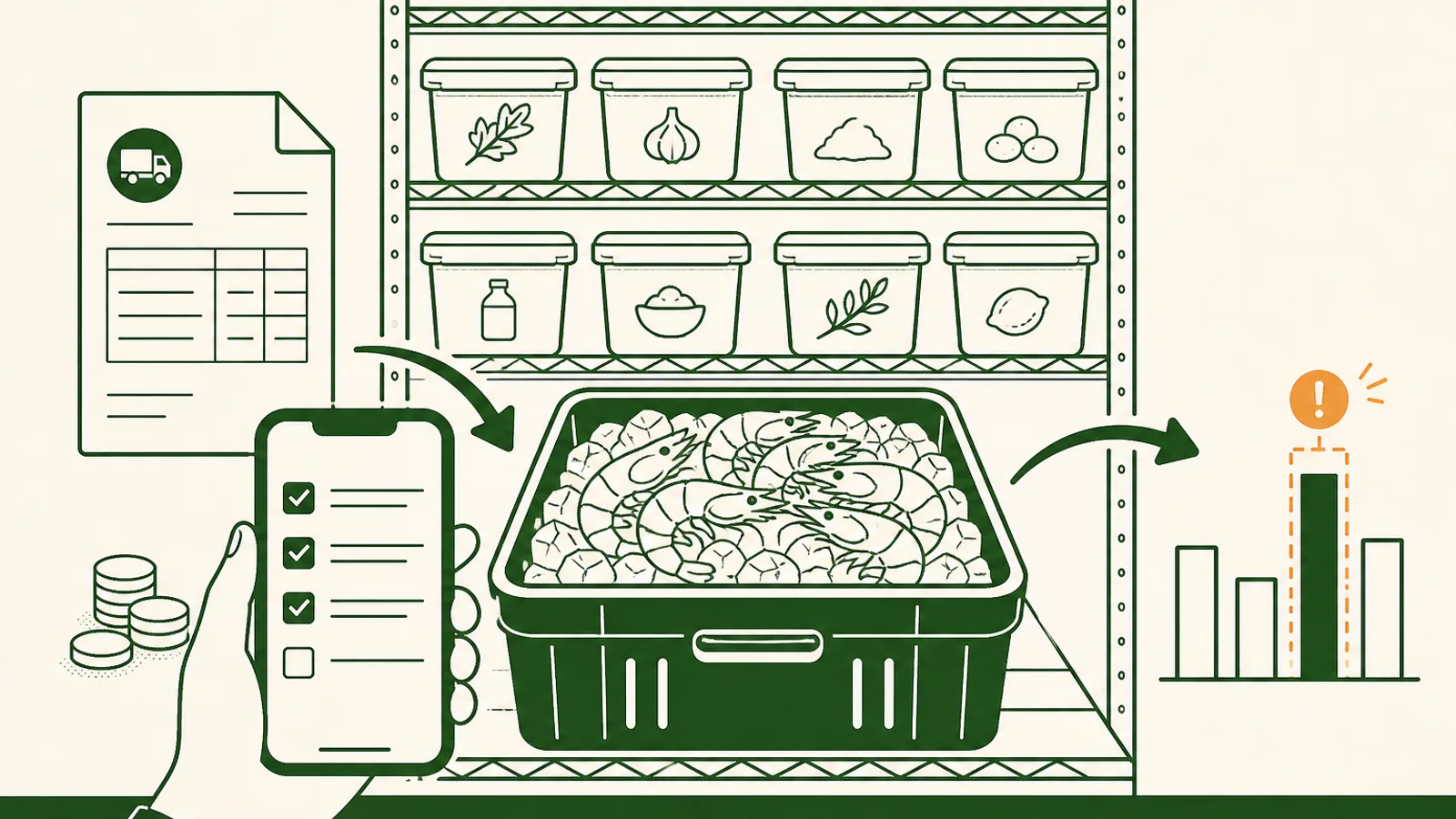
Restaurant inventory management software earns its keep at a specific point in a restaurant's life, and that point is not opening day. It is the week you realise you can no longer answer a simple question: given everything we sold since Monday, how much beef should be in the walk-in right now? If you can answer that from a spreadsheet in under a minute, keep the spreadsheet. If you cannot, the gap between what your recipes say you used and what actually left the store is costing you money every week, quietly, and no amount of careful buying will find it for you.
This is written for the owner or GM making that call, not for a procurement committee. What this software actually does, when a spreadsheet is still the honest answer, the four signals that say you have outgrown one, what the switch is worth in baht at your revenue, and how to roll it out in two weeks without stopping service.
What restaurant inventory management software actually does
Strip away the feature lists and there are four jobs.
- An ingredient list that knows its own price. Every ingredient with a unit and a current cost per unit, updated from what you actually paid last week, not from a quote in March.
- Recipes costed to the gram. A dish maps to its ingredients with weights, and that mapping has to include modifiers. Extra cheese pulls another 30g. "No rice" puts the rice back. If the modifiers are not mapped, your costs drift on exactly the dishes people customise most.
- Automatic depletion. A Pad Thai sells, and the noodles, sprouts, egg and prawns come off on-hand without anyone typing anything.
- Receiving and counting. Deliveries land as goods receipts that update both quantity and cost. Counts, done by area, give you reality to compare against.
The output that matters is one line per ingredient: what you should have, versus what you do have, priced in baht and ranked biggest first. That list is the entire product. Everything else is plumbing to produce it.
One structural detail decides whether any of this works: the depletion is only as good as the software's knowledge of the sale. A standalone inventory app that imports a sales file overnight gives you yesterday's picture plus a reconciliation job you did not have before. Papaya Stock sits inside the same system that takes the order, so a plate's cost moves as the sale happens rather than at month end. If you already run MarketMan, Papaya connects to it rather than asking you to rip it out.
When a spreadsheet is still the honest answer
We sell this software, so weigh what follows accordingly, then check it against your own numbers anyway.
A spreadsheet is genuinely fine when all of the following are true: one outlet, fewer than roughly 60 ingredients, a menu that does not change much, the owner does the buying and sees every invoice, and food cost is under about 32% and steady. In that shape, a monthly count and a costed recipe sheet will hold. The tool is not your constraint.
Run the numbers for a small café. At ฿250,000 a month in food sales and a 30% food cost, you are buying ฿75,000 of ingredients. One point of food cost is ฿750 a month. Ingredient-level stock control costs ฿1,500 per outlet per month more than the POS-only plan, so you need two full points before the subscription breaks even, and that is before you count the hours. At that size, the habits that cut food cost matter far more than the tooling: portion to spec, log waste, re-cost your top ten dishes each quarter.
Four signals you have outgrown it
You cannot answer "what should be left". This is the cleanest test there is. Ask it about your most expensive ingredient right now. If the honest answer is "I would have to work it out", you have no theoretical on-hand, which means you have no variance, which means waste and over-portioning are invisible to you by construction.
Supplier prices moved and your recipe costs did not. Thai food prices rose 2.04% year on year in July 2026, which sounds harmless. Averages always do. The average hides a 15% jump in prawns against a flat month for rice, and it is the prawns that are on your signature dish. A recipe costed six months ago is not a slightly stale number, it is fiction, and every decision you make on top of it inherits the error.
A second outlet or a central kitchen appeared. The moment you produce curry paste in one place and use it in three, you need transfers that carry cost as well as quantity. Without that, one outlet looks unfairly expensive, another looks impossibly cheap, and the group food cost is an average of two wrong numbers.
You can feel waste but cannot name it. This is the expensive one, because the fix is well evidenced. A Champions 12.3 review of 114 restaurant sites across 12 countries found the average site saved $7 for every $1 invested in cutting kitchen food waste, and cut waste 26% in the first year. Read the mechanism, though, not just the ratio: every one of those sites started by measuring. Nobody reduced waste they were not tracking.
The baht maths at a real restaurant
Take a mid-size Bangkok restaurant doing ฿1.2 million a month in food sales at a 34% food cost. That is ฿408,000 of ingredients a month, and one point of food cost is ฿12,000.
Against that, the software is not the interesting number. On Papaya's pricing, POS Pro is ฿2,490 per outlet per month and POS + Inventory Pro is ฿3,990, so ingredient-level stock control is a ฿1,500 step up. The subscription pays for itself at about one eighth of a point of food cost. Nobody sensible should agonise over that.
The number that decides it is time. Budget one day to set up your top 20 ingredients by spend, which will usually be 80% of what you buy, plus recipes for your ten best sellers. Then 25 to 40 minutes for a weekly count and about 20 minutes reading the variance. Call it two hours a week of someone's real attention, forever. That is the actual price, and it is the one that gets skipped in the demo.
What operators typically find in the first quarter is two to four points, which on ฿1.2 million is ฿24,000 to ฿48,000 a month. Those points do not arrive because the software found them. They arrive because somebody read a ranked variance list on Monday morning, saw that the pork belly gap was ฿9,400, and changed one thing. Software nobody reads is a subscription, not a saving.
What to check before you buy
- Does the sale deplete the stock, natively? Ask to see a live sale move an ingredient's on-hand. If the answer involves a nightly file, you are buying two systems and a reconciliation habit.
- Are modifiers mapped to ingredients? Options, add-ons and swaps are where costing quietly falls apart.
- Prep and batch recipes. Thai kitchens run on curry pastes, stocks and sauces made in bulk. A system that only costs finished dishes cannot handle the way your kitchen actually works.
- How long does one delivery take to book in? Time it in the demo, with a real invoice. Receiving is the step that gets abandoned first when it is slow. Photographing the invoice and reviewing the parsed lines is the fast version, though if your suppliers still hand you a handwritten bill, somebody is checking those lines either way.
- Counts by area, on a phone. Walk-in, dry store, bar. Counting on a clipboard and typing it up later is how weekly counts become monthly counts and then stop.
- A variance report in baht, ranked. Percentages are a trap. A 30% variance on a ฿400 garnish is noise; a 6% variance on ฿40,000 of prawns is your rent.
- Transfers with value attached, if you have more than one location, and an export of your own data if you ever leave.
A two-week rollout that does not stop service
Week one, back office only. Pull your last month of invoices and list the top 20 ingredients by spend. Set units carefully, because most bad stock data is a kilogram-versus-gram problem, not a counting problem. Enter current prices. Build recipes for your ten best-selling dishes and map their modifiers. Nothing changes on the floor this week.
Week two, run it in parallel. Receive every delivery through the system as it arrives. On Sunday night, count only those 20 ingredients, which takes about half an hour. On Monday, read the variance list and pick the single biggest line in baht. Ask one question about it: is this a buying problem, a portioning problem, or a waste problem? Assign the fix to one person and stop there.
From week three, widen slowly. Add ten ingredients and five recipes a week until the long tail is covered. Do not try to reach 100% coverage before the first count. The spice rack can wait; the protein cannot.
By the end of the second week you will know something more useful than any vendor demo can tell you: whether your team will actually count. If they will, the numbers above are conservative. If they will not, no software fixes that, and you are better off spending the ฿1,500 a month on a set of decent scales and a portioning briefing.
Frequently asked questions
What does restaurant inventory management software actually do?
Four things: it holds your ingredients with their units and current cost, costs each recipe down to the gram, depletes those ingredients automatically as dishes sell, and reconciles that theoretical figure against a physical count. The output that matters is one line per ingredient showing what you should have versus what you do have, priced in baht and ranked biggest first.
When should a restaurant stop using a spreadsheet for stock?
When you cannot answer what should be left without doing arithmetic, when supplier prices have moved and your recipe costs have not been updated in months, when a second outlet or a central kitchen appears, or when the monthly count keeps telling you something went wrong four weeks too late to fix. One outlet, a short stable menu and an owner who does the buying can run a spreadsheet honestly for a long time.
How much does restaurant inventory management software cost in Thailand?
On Papaya, ingredient-level stock sits on the POS + Inventory Pro plan at ฿3,990 per outlet per month, which is ฿1,500 above the equivalent POS-only plan. At ฿1.2 million a month in food sales, one point of food cost is about ฿12,000, so the subscription is not the deciding number. The real cost is roughly two hours a week of someone's attention on counting and reading the variance.
Do I still need to count stock if the software tracks it automatically?
Yes, and that is the point. The software gives you the theoretical on-hand: what should be left based on what sold. The count gives you reality. The difference between the two is the variance, and the variance is the only number that tells you about over-portioning, spoilage and shrinkage. Software with no counts is a very confident guess.
Can it handle a central kitchen or a second outlet?
It has to, if you have one. Look for inter-outlet transfers that carry cost as well as quantity, so a batch of curry paste produced centrally lands on the receiving outlet's COGS at what it actually cost to make. Without that, each outlet's food cost is wrong in opposite directions and the group number means nothing.
Buy the visibility, then use it
Restaurant inventory management software does not save you money. It shows you where the money went, in baht, ranked, on a Monday morning while you can still do something about it. The saving comes from the person who reads that list and changes one thing a week. Every kitchen that has held its food cost down did it that way, with or without software.
So the buying decision is smaller than vendors make it sound. Work out whether you can still answer what should be left in your walk-in right now. If you can, keep your spreadsheet and put the effort into portioning and waste discipline instead. If you cannot, you are already paying for the gap. You may as well start measuring it.
COGS calculator
Calculate cost of goods sold from opening and closing stock.
More on Food cost & margin
Cost your recipes, cut waste and protect margin without touching the menu.