How to cut your food cost to 28% without changing the menu
A practical, operator-tested playbook for getting food cost down to 28% of sales without dropping a single dish — track every ingredient, cost your recipes, count weekly, and act on your three biggest variances.
You do not need to cut dishes or shrink portions to reach a 28% food cost. Track every ingredient you buy, cost each recipe to the gram, count stock weekly, and act on the three biggest gaps between what you should have used and what you actually did. Most kitchens find three to five points of margin hiding in portioning, waste and supplier drift.

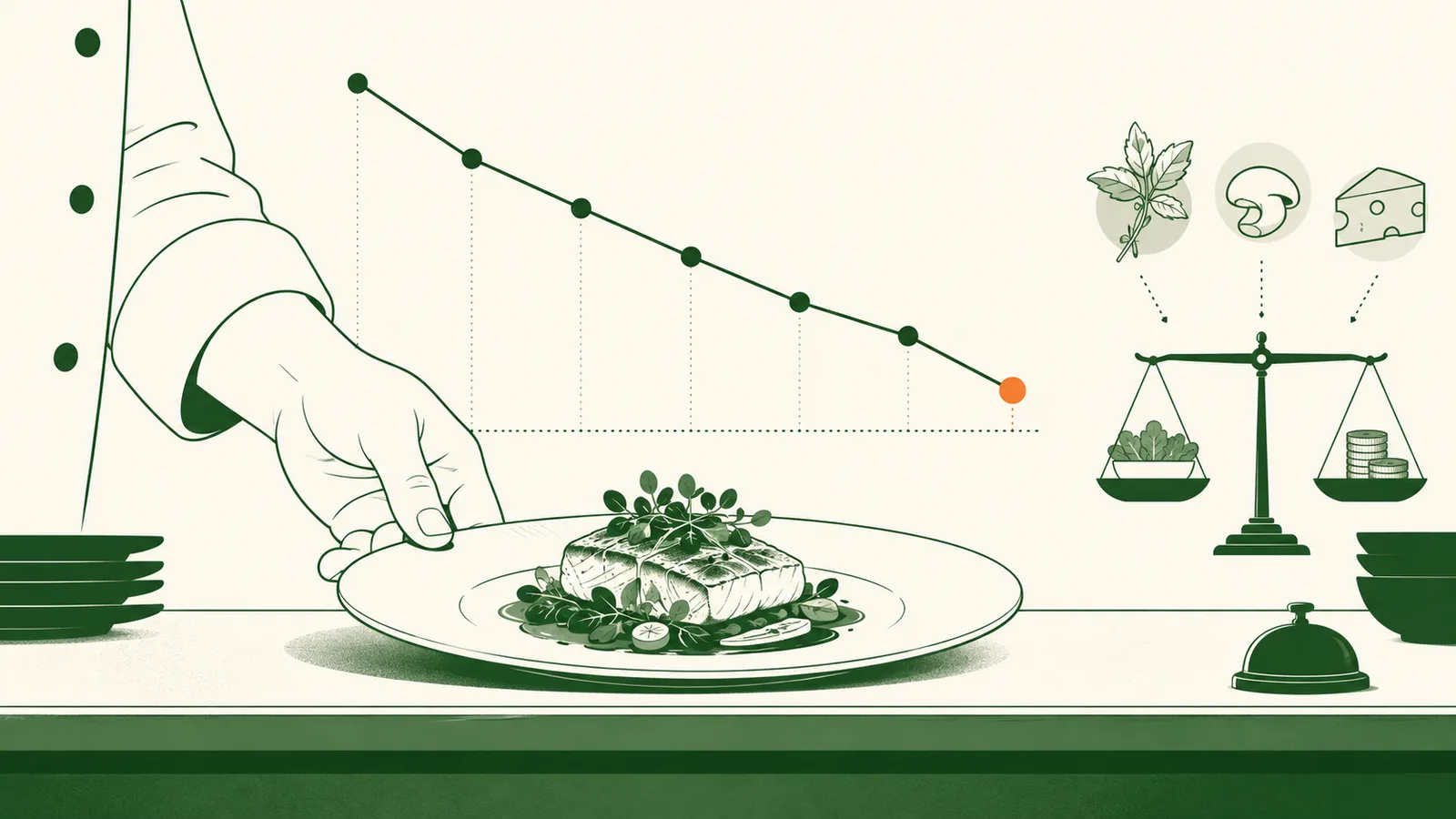
Here is the short answer: track every ingredient you buy, cost each recipe down to the gram, count your stock weekly, and act on the three biggest variances between what you should have used and what you actually did. No new dishes, no smaller portions, no cheaper supplier. Most kitchens that do this honestly for one month find three to five points of margin hiding in plain sight.
If you have ever finished a busy month, looked at the bank balance, and thought "where did it all go?" — the answer is almost always food cost. It is the largest variable expense in a restaurant, and unlike rent or wages, it moves every day with how your kitchen actually runs. A plate that should cost ฿62 in ingredients quietly becomes ฿78 when portions creep up, a tray of prawns spoils, or a new cook over-pours the sauce. Nobody decided that. It just happened.
The good news: getting to 28% almost never requires touching the menu. You do not need to shrink portions guests will notice, swap to a worse supplier, or cut the dishes people come back for. You need visibility — knowing what each dish costs, what you bought, and what should be left. That gap, between theoretical and actual, is where the money is.
Cost every recipe down to the gram
You cannot manage a number you have never calculated. Take your ten best-selling dishes and write down every ingredient with its weight: 180g of rice noodles, 60g of bean sprouts, 4 prawns at 18g each, 30ml of tamarind sauce. Multiply each by its cost per gram from your last invoice, add it up, and you have the plate cost. Divide by the menu price and you have that dish's food-cost percentage.
Almost every operator gets a surprise here. One signature dish is running at 41% because prawn prices climbed and the menu price never followed. Another — usually a drink or a side — is sitting at 14% and quietly subsidising the rest. You are not going to delist the 41% dish; it is why people walk in. But now you can re-engineer it: trim the garnish that goes back to the kitchen uneaten, standardise the portion with a scoop instead of a handful, or nudge the price ฿10.
Sort by baht, not by percentage
A 30% variance on a ฿40-a-week garnish is noise. A 6% variance on the prawns you buy ฿40,000 of is your rent. When you rank what to fix, rank it in money, not in percentages, and only look at the top of the list.
Track every ingredient that comes in the back door
Recipe costs only mean something if your purchase prices are current. Prawns, cooking oil, and leafy vegetables can swing 20% week to week. If you are still costing a dish on a price from three months ago, your numbers are fiction.
The fix is mundane but decisive: capture every goods-receipt as it lands. The fastest way is to photograph the supplier invoice the moment it arrives, so the line items, quantities and prices get read off and matched to your ingredients automatically. Do this for a month and you will spot the supplier who has been creeping prices ฿3 at a time, and the order that arrived 2kg short of what you paid for.
- Receive against the order. Match what arrived to what you ordered — short deliveries are pure margin loss.
- Let each sale deplete stock. When a Pad Thai sells, the noodles, sprouts and prawns come off your on-hand automatically.
- Keep a movements ledger. Every receipt, transfer, waste entry and sale in one place you can actually audit.
If you want every sale to deplete the right ingredients automatically and keep your cost-per-gram live, that is exactly what Papaya Stock is built to do.
Count weekly — yes, weekly
A monthly count tells you something went wrong four weeks too late to fix it. A weekly count of your high-value, high-movement items — proteins, oil, alcohol, cheese — turns food cost into a steering wheel instead of a rear-view mirror. It takes one person 25 minutes if your counts live on a phone instead of a clipboard.
When you count, you compare on-hand against what the system thinks you should have, given everything you sold. The difference is variance, and variance has a small number of usual suspects: over-portioning, waste and spoilage, comps that never got rung in, and theft. You do not need to solve all four. You need to find which one is costing the most this week and put one fix in place. Next week, you will see if it worked — that feedback loop is the whole game.
Act on the three biggest variances — and ignore the rest
This is where most cost-cutting drives fail: people try to fix everything and burn out by week two. Do not. For each of the top three variances, ask one question: is this a buying problem, a portioning problem, or a waste problem?
- Buying gets fixed with a renegotiation or a switch.
- Portioning gets fixed with a scale, a scoop, and a five-minute line briefing.
- Waste gets fixed with prep discipline and rotation.
Pick the fix, assign it to one person, and move on. Three good fixes a week, compounded over a month, is how 34% becomes 28% — quietly, without a single guest noticing.
Frequently asked questions
What is a good food cost percentage?
Most full-service restaurants aim for 28 to 32% of sales, though it varies by concept: a bar or café can run lower, a steakhouse higher. The number that matters is your own trend, costed per dish, tracked weekly, moving in the right direction.
How do I lower food cost without changing the menu?
Tighten portioning to spec, log and cut waste, re-cost recipes against current supplier prices, and fix the few dishes where theoretical and actual usage diverge most. None of that touches what is on the menu.
How often should I count stock?
Weekly is the sweet spot for most kitchens: often enough to catch variances while they are still actionable, not so often it eats the day. Count the high-value, fast-moving items most carefully.
Cut the waste, then keep it cut
Getting to 28% is rarely about one big decision. It is a handful of small gaps — a portion that crept up, a supplier price that drifted, a tray that spoiled — each costing a point or two of margin until you can see them. Cost your recipes, count weekly, and act on your three biggest variances first.
The harder part is keeping it there once the busy weeks return. That is why the operators who hold 28% treat it as a weekly habit, not a one-off project: a standing count, a costed menu that updates with prices, and a short list of variances to work through every week.
Food-cost calculator
Work out the plate cost and margin of any menu item.
More on Food cost & margin
Cost your recipes, cut waste and protect margin without touching the menu.